The Science of the Kick: How Taekwondo, Capoeira, and Savate Developed the World's Most Spectacular Striking
A Technical and Cultural Exploration of Kick-Dominant Martial Arts
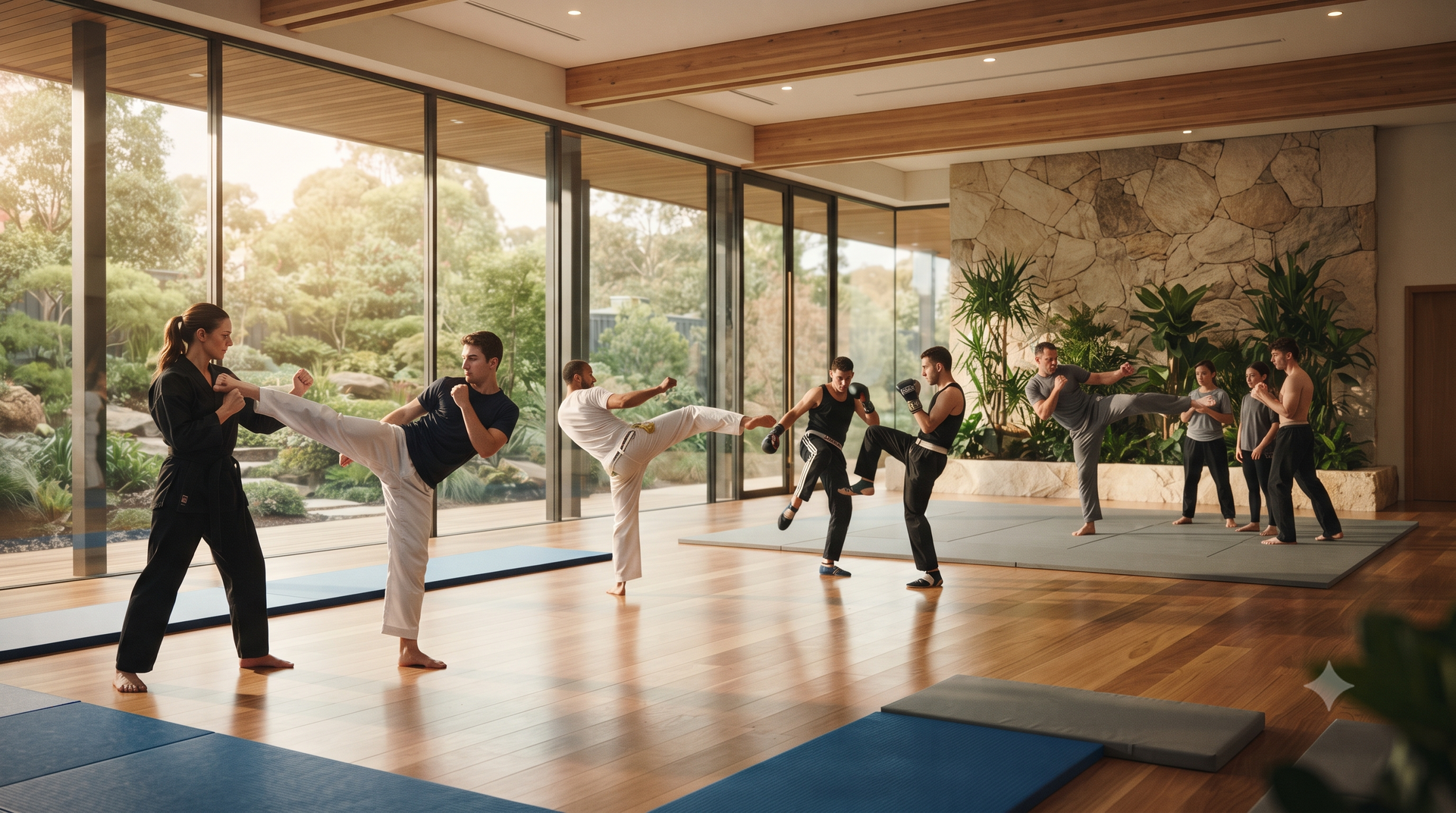
A punch travels roughly sixty centimetres from a shoulder. A properly executed roundhouse kick travels nearly two metres, generates forces three to four times greater than a comparable punch, and arrives at a target the opponent can barely reach with their own hands. In purely mechanical terms, the kick is the most devastating natural weapon the human body produces. Which raises a fascinating question: why did so few cultures build their martial arts around it?
The answer is context. Most battlefield arts prioritised weapons over empty hands, and when fighters were grappling in close quarters, a kick became a liability. But certain traditions — isolated, civilian-focused, or simply brilliant in their innovation — saw what others missed. They developed the kick into an art form. Three of those traditions are the focus of this article: Taekwondo from Korea, Capoeira from Brazil, and Savate from France. Each arrived at the supremacy of the leg through a completely different cultural and historical journey.
Taekwondo: Engineering the Perfect Kick
Taekwondo is, by any measure, the most kick-centric martial art in the world. Its name says so explicitly — 'Tae' means to strike with the foot, 'Kwon' means to strike with the hand, and 'Do' means the way or path. But this is misleading in one direction: while the hands are acknowledged, the feet are the art's true obsession.
Modern Taekwondo has its roots in traditional Korean martial arts — specifically Taekkyeon and Subak — that date back over two thousand years. These systems were characterised by fluid leg techniques and rhythmic footwork, quite different from the rigid, linear stances of Japanese karate that influenced Taekwondo's formalisation in the twentieth century. The synthesis produced something remarkable: a system with the structured discipline of Japanese arts and the acrobatic leg arsenal of Korean tradition.
What makes Taekwondo kicking technically exceptional is its biomechanical precision. Students are taught from day one how to use hip rotation to generate power, how to chamber the knee before extension to create speed, and how to pivot on the support foot to maximise torque. The back kick — a linear heel thrust driven by a 180-degree pivot — is widely acknowledged as producing the highest force-per-unit-speed of any unarmed technique in martial arts. The spinning heel kick adds a rotational component that creates additional kinetic energy before impact.
Beyond the technical, Taekwondo has a remarkable competition infrastructure. Its inclusion in the Olympic Games since 2000 has brought the art to a global audience, and Australia has produced multiple world-class competitors through the national pathway. The point-scoring system in Olympic Taekwondo has evolved to reward head kicks and spinning techniques — which has driven a generation of practitioners to develop extraordinary aerial kicking ability that would have seemed impossible to earlier generations.
Critics sometimes argue that Olympic-format Taekwondo has drifted away from practical self-defence application. That argument has merit in narrow contexts. But it misses the broader picture: the conditioning, agility, reflexes, and psychological toughness developed through serious Taekwondo training have profound practical value that extends well beyond the ring.
Capoeira: The Kick Hidden in a Dance
Of all the kicking arts, Capoeira is the most visually astonishing and the most philosophically layered. To the uninitiated, watching two capoeiristas perform the 'jogo' — the game — looks like a rhythmic, acrobatic dance accompanied by the twang of a berimbau. It is only when you slow the footage down that you see what is actually happening: a continuous exchange of kicks, sweeps, evasions, and feints so fluid that they merge seamlessly with the movement itself.
Capoeira was born from necessity. Developed by African slaves in Brazil during the sixteenth and seventeenth centuries, it was a martial art that had to disguise itself as something else. Slavery prohibited the practice of combat arts, so practitioners embedded their techniques within music and dance, creating a system that could be trained openly while concealing its true purpose. The result was something genuinely unique in the history of martial arts: a combat discipline in which deception and misdirection were baked into the fundamental structure of the movement.
The primary kicks of Capoeira — the meia lua de frente (half-moon kick to the front), the armada (spinning outside crescent kick), the martelo (hammer kick), and the devastating queixada — are all designed to flow seamlessly from and into evasive movements. Where Taekwondo teaches you to plant your foot and drive your kick with maximum power from a stable base, Capoeira teaches you to never be where your opponent expects you, and to attack from angles of constant movement. The ginga — the signature swaying step — ensures that a capoeirista is always in motion, always presenting a moving target.
What this produces is a practitioner with extraordinary body awareness, balance, and coordination. The acrobatic elements — the au (cartwheel), the bananeira (handstand), the macaco (backflip) — are not showmanship. They are functional evasion tools that the art uses as fluidly as a boxer uses a slip or roll. Training Capoeira develops spatial awareness and proprioception at a level few other arts can match.
In Australia, Capoeira has a dedicated and growing community, particularly in larger cities. Groups (known as 'groups' or 'academies') often retain strong cultural connections to Brazilian tradition, maintaining the Portuguese language in commands and music, and observing the hierarchical belt system (a cord system distinct from the Japanese belt tradition). The cultural dimension of training — the music, the history, the community — is as important to most practitioners as the physical techniques themselves.
Savate: The Gentleman's Kicking Art
French Savate occupies a unique position in the kicking arts for one simple reason: it is the only traditional striking art in the world that permits kicking with a shod foot. Practitioners wear shoes — light, purpose-built leather footwear — that allow them to use the toe, instep, heel, and sole as distinct striking surfaces. This single design decision produced a kicking system that is unlike anything else in martial arts.
Savate developed in nineteenth-century France, emerging from the rough street fighting culture of Marseille's port district before being refined and systematised in Paris. Early practitioners combined French kickboxing with English boxing — which was already a well-developed sporting art — to create a combat system that used the full body as a weapon. The French word 'savate' itself is an old term for a worn-out shoe, a reference to the early association between kicking and the rough-and-tumble of the docks.
The kicks of Savate are distinguished by their precision and their commitment to targeting specific anatomical zones. The fouetté (whip kick) strikes with the toe of the shoe to the thigh, ribs, or face. The chassé (side or front kick) uses the heel or sole in a pushing, linear thrust. The revers (reverse kick) sweeps outward with the instep. Each technique is designed to deliver concentrated force to a precise target — more like a surgeon's instrument than a sledgehammer.
Savate's relationship with boxing is integral to its identity. Unlike arts that treat hands and feet as separate departments, Savate practitioners are trained as complete fighters where punching and kicking combinations flow into one another naturally. The movement is upright, footwork is active and dynamic, and there is a strong emphasis on reading and controlling distance — a concept borrowed directly from French boxing tradition.
Savate is less widely available in Australia than Taekwondo or Capoeira, but dedicated schools do exist, and for the practitioner seeking a unique and historically rich kicking art with strong self-defence application and a distinctive cultural identity, it represents a genuinely rewarding path.
What the Science Tells Us
Modern biomechanical research has confirmed what martial artists have known intuitively for centuries: the leg is the most powerful striking tool available to a human being. Studies measuring force output across martial arts techniques consistently show that spinning heel kicks and back kicks produce peak forces in the range of 2,000 to 4,000 newtons — several times the force of an average punch. The combination of greater mass (the leg is roughly three to four times heavier than the arm), longer lever length, and the ability to engage the hip and core rotational system simultaneously gives the kick its extraordinary mechanical advantage.
But raw force is only part of the story. Each of the three arts covered here has developed its kicking system to optimise a different variable. Taekwondo maximises speed and elevation — the ability to reach targets above the shoulder line that hands cannot easily access. Capoeira maximises deception — the ability to disguise the origin and direction of a kick within flowing movement. Savate maximises precision — the ability to deliver targeted force to specific anatomical points from a controlled, boxing-influenced stance.
For the martial artist designing a well-rounded striking curriculum, there is enormous value in studying across these traditions. A Taekwondo-trained leg, a Capoeira-trained sense of spatial deception, and a Savate-trained understanding of targeting and combination flow together in ways that no single style can fully replicate.
Developing Your Kicking Game in Australia
Australia has active communities for all three arts. Taekwondo clubs are abundant, often affiliated with Taekwondo Australia, with strong junior programs and clear competition pathways. Capoeira groups operate in most capital cities, frequently offering immersive cultural experiences alongside technical training. Savate schools are rarer but discoverable through national martial arts directories and dedicated online communities.
Whichever path you choose, developing genuine kicking ability requires patience, consistent practice, and a willingness to develop the hip mobility and postural strength that good kicking demands. The leg is the most powerful weapon you have. Learning to use it well is a journey worth taking.