Hapkido Explained
The Art of Circular Motion, Joint Control, and Whole-Body Defence
A Different Kind of Korean Martial Art
When most people think of Korean martial arts, they think of Taekwondo — the high-kicking, Olympic-featured style that has become one of the world's most recognised martial arts. Hapkido is less globally prominent, but among those who know it, it commands deep respect as one of the most comprehensive and practically effective self-defence systems in the Korean tradition.
Where Taekwondo emphasises dynamic striking and particularly kicking, Hapkido takes a broader strategic approach — combining strikes, kicks, throws, joint locks, and pressure point techniques into a system designed to work against opponents of any size and under real-world conditions. At Martial Arts Australia, Hapkido is one of the systems we most consistently recommend to students whose primary interest is practical self-defence capability rather than sport competition.
Origins and History
Hapkido's 20th-century development is primarily attributed to Choi Yong-Sul, a Korean martial artist who is said to have trained extensively in Daito-Ryu Aikijujutsu in Japan under Sokaku Takeda before returning to Korea following the end of the Japanese occupation in 1945. Choi called his system Hapkido — a name derived from three Korean characters meaning harmony (hap), energy/life force (ki), and way or art (do) — and taught it in Daegu beginning in the late 1940s.
Subsequent development of Hapkido involved synthesis with native Korean martial arts traditions — particularly the kicking emphasis of traditional Korean systems — resulting in the fuller striking and kicking arsenal that characterises modern Hapkido. Several of Choi Yong-Sul's senior students went on to develop their own significant contributions to the system, and the various Hapkido organisations today reflect the diversity of these developmental lineages.
The Three Core Principles
Hapkido's technical and strategic character is defined by three core principles that distinguish it from both the striking-focused Korean arts and the throwing-focused Japanese systems it is sometimes compared to:
Circular Motion (Won)
Rather than opposing force directly, Hapkido principles call for circular redirection — using the opponent's force against them by adding to its direction and bringing it to a resolution through circular movement. This principle is most visible in Hapkido's wrist and arm locks, where the practitioner uses a circular controlling motion to create leverage over the joint rather than trying to stop the incoming force directly.
Flow and Redirection (Yu)
Water is the most common metaphor in Hapkido instruction — the idea that effective technique flows around resistance rather than confronting it. When an opponent resists one technique, Hapkido training develops the ability to flow seamlessly into another, following the opponent's reaction rather than fighting against it. This principle gives skilled Hapkido practitioners a fluid adaptability that is genuinely difficult to defend against.
Non-Resistance (Hwa)
The harmony principle holds that the most effective response to incoming force is not equal and opposite force, but the yielding, redirection, and control that allows the practitioner to resolve the encounter without unnecessary escalation. This principle connects Hapkido to the broader tradition of internal or soft martial arts, even though Hapkido is in many respects a relatively hard, striking-based system.
The Technical Range of Hapkido
What makes Hapkido particularly comprehensive as a self-defence system is the breadth of its technical repertoire. A competent Hapkido practitioner is comfortable operating at every range of engagement:
- Kicking and striking — Hapkido includes a wide variety of kicks, including many of the same circular and spinning techniques found in Taekwondo, alongside palm strikes, punches, and elbow techniques. The striking tools address the long and medium ranges.
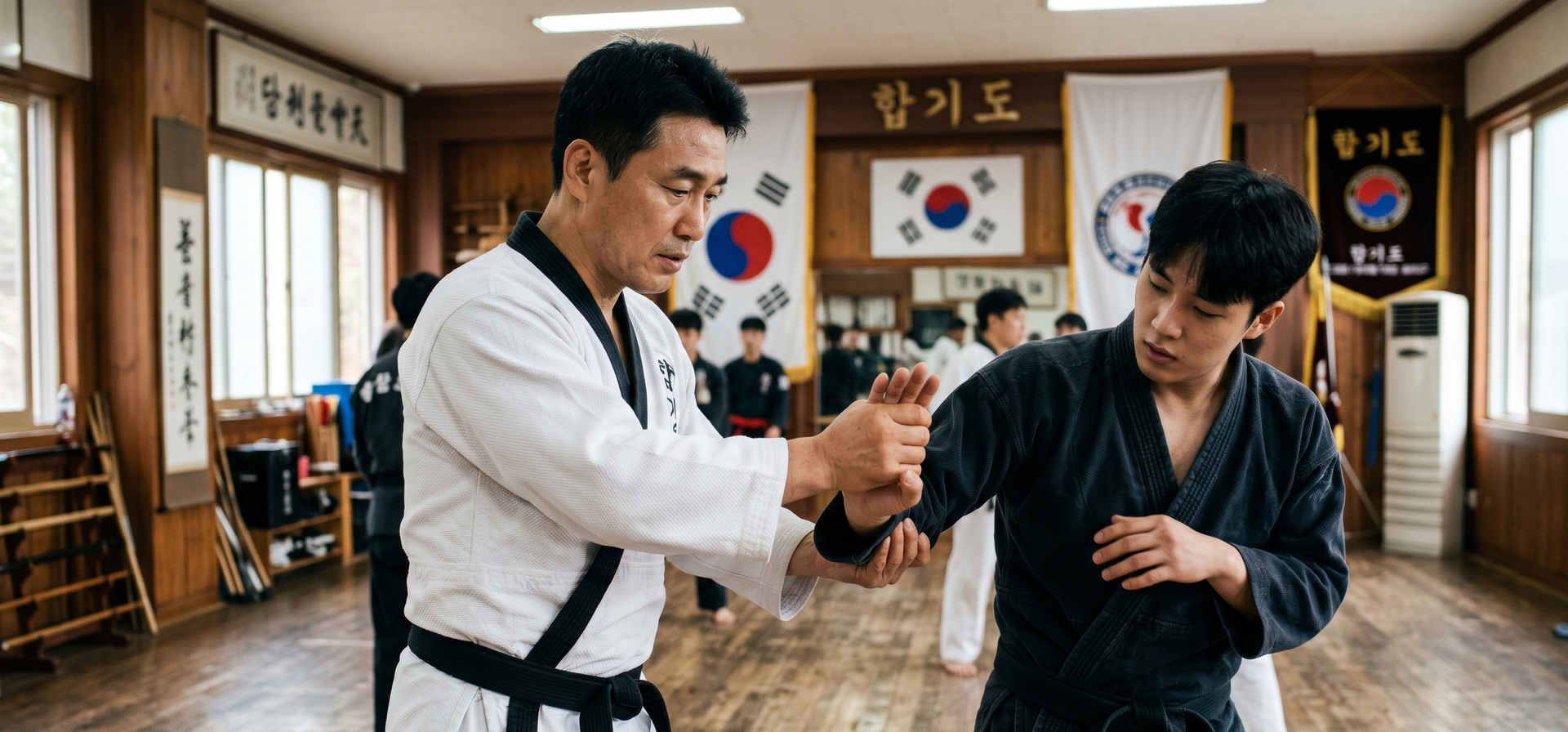
- Joint locks and control techniques — Hapkido's most distinctive technical domain. Wrist locks, elbow locks, shoulder locks, and finger locks give the practitioner the ability to control, redirect, and immobilise an opponent without necessarily striking them. This is particularly valuable in situations — professional, social, or legal — where causing injury is undesirable.
- Throws and takedowns — Hapkido includes a range of hip throws, leg sweeps, and sacrifice throws that allow the practitioner to take an opponent to the ground decisively when the situation demands it.
- Ground control — while Hapkido is primarily a standing system, its joint lock repertoire extends to ground positions, allowing practitioners to maintain control of a downed opponent.
- Weapons — traditional Hapkido training includes cane, short stick, rope, and knife defence, making it particularly relevant to the self-defence context.
Hapkido for Self-Defence
Hapkido's principles and technical range make it one of the most practically oriented traditional martial arts for real-world self-defence. The combination of striking capability (for situations requiring immediate resolution), joint control techniques (for situations requiring control without injury), and throwing skills (for creating distance or ending a confrontation) covers a wider range of realistic scenarios than any single-emphasis system can address.
The circular, redirection-based principles also mean that Hapkido techniques function without requiring the practitioner to match the opponent's size or strength. This makes it particularly valuable for smaller practitioners and is one of the reasons it has historically been a favoured system for bodyguards, law enforcement, and military personal protection applications in Korea.
Hapkido in Australia
Australia has a well-established Hapkido community, with schools operating across all major states and represented by multiple association structures. The quality of instruction varies, and the diversity of lineages within Hapkido means that different schools emphasise different aspects of the system. Prospective students should seek out instructors who can demonstrate technical competence across the full range of the system — not just the kicking elements that are easiest to display — and who teach the underlying principles alongside the techniques.