Hung Ga Kung Fu
Strength, Rootedness, and the Proud Legacy of Southern Chinese Martial Arts
The Power of the South
If you want to understand why southern Chinese martial arts developed differently from their northern counterparts, Hung Ga Kung Fu is one of the best places to start. This powerful, rooted system — one of the dominant styles of Guangdong Province and the primary fighting tradition of the Cantonese diaspora — embodies the strategic and philosophical priorities of the southern Shaolin tradition with a directness and strength that is immediately recognisable to anyone who has witnessed it practised well.
Hung Ga, sometimes written Hung Gar, takes its name from the Hung family — specifically from Hung Hei-Gun, a historical figure of the late Qing Dynasty period credited with systematising the art following the burning of the southern Shaolin Temple. The connection to the Shaolin tradition is deep: Hung Hei-Gun is said to have trained at the temple before its destruction, and much of Hung Ga's character reflects the southern Shaolin emphasis on powerful stances, short-range power, and the cultivation of internal as well as external strength.
The Physical Character of Hung Ga
Hung Ga is immediately identifiable by several distinctive physical characteristics that distinguish it from other southern Chinese systems:
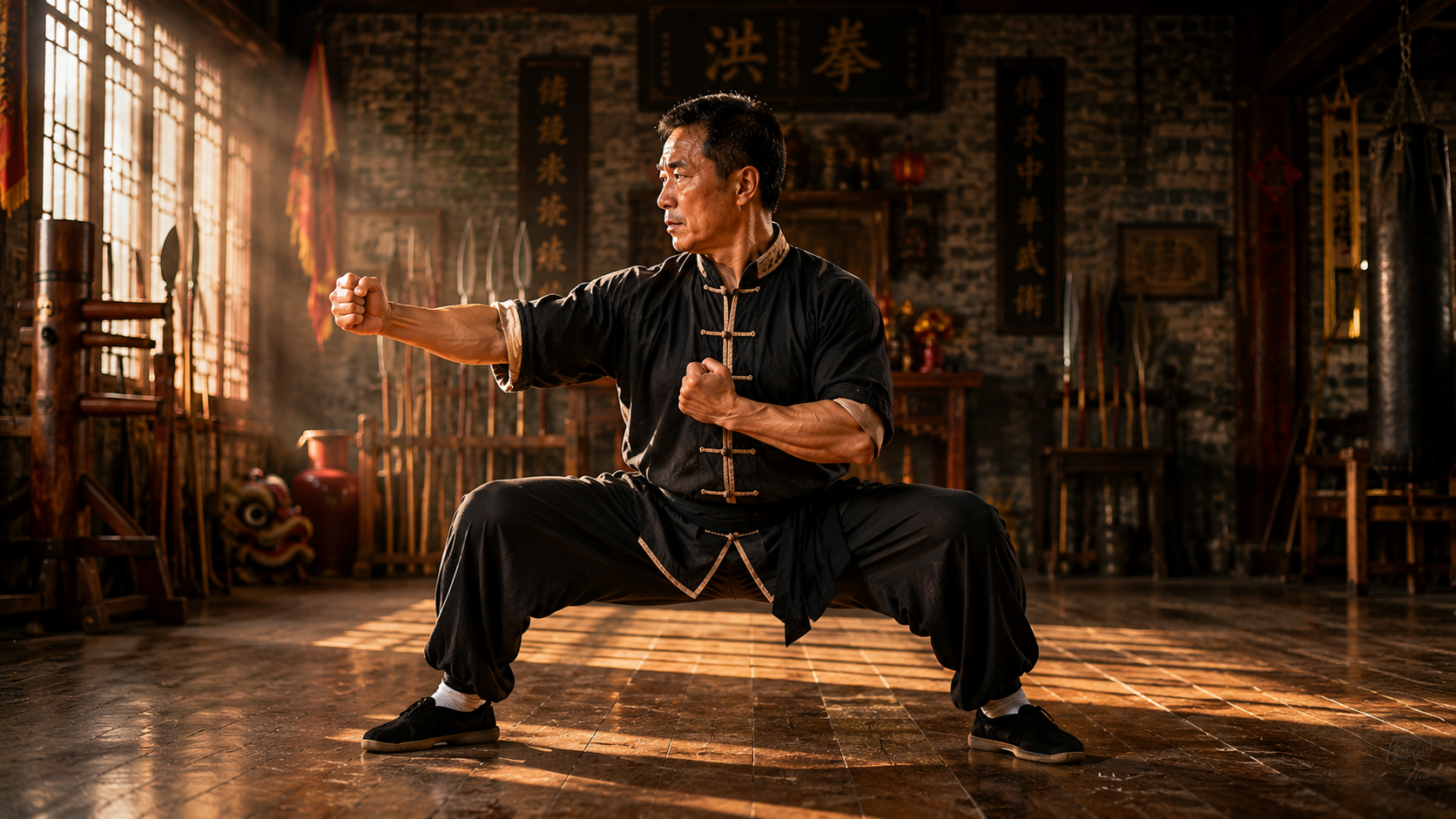
- Low, wide stances — the horse stance (ma bu) in Hung Ga is not merely an exercise. It is the foundation of the system's power generation. Hung Ga practitioners spend considerable time developing deep, stable stances that create the rooted base from which force is expressed. This emphasis on low, stable positioning reflects the system's strategic preference for close-range power over speed and evasion.
- Short-range power — like many southern systems, Hung Ga generates force over short distances. The bridges — the forearm contact points used to connect with and control an opponent — are trained extensively, with emphasis on generating power from a stable base rather than relying on the momentum of large movements.
- Iron Wire training — arguably the most famous aspect of Hung Ga training is the Iron Wire (Tit Sin Kuen) form, a specialised qigong and strength conditioning form that develops internal force, iron shirt conditioning, and the cultivation of a quality of toughness and resilience that extends well beyond physical strength alone.
- The tiger claw — the tiger claw technique is central to Hung Ga's fighting repertoire. Used for gripping, tearing, and control, the claw technique is trained as both a physical conditioning method and a fighting tool, developing grip strength and the ability to seize and control an opponent.
The Five Animals and Five Elements
Hung Ga incorporates the five animal framework familiar from other Shaolin-derived systems — Tiger, Crane, Leopard, Snake, and Dragon — with each animal contributing different qualities to the practitioner's repertoire. Tiger develops power and aggression; Crane contributes balance and precision; Leopard adds speed; Snake develops sensitivity and flexibility; Dragon cultivates spirit and the ability to generate force from the whole body.
The system also incorporates the five elements theory — Metal, Wood, Water, Fire, and Earth — mapping these conceptual frameworks onto specific striking techniques and training principles. This dual framework gives Hung Ga a remarkable depth of material to study, and experienced practitioners often spend decades exploring the layered meanings within even the most fundamental techniques.
The Key Forms
Hung Ga's curriculum is centred on several foundational forms that collectively build the complete practitioner:
- Gung Gee Fok Fu Kuen (Taming the Tiger) — the primary introductory form, building the foundational stances, hand techniques, and power generation methods of the system.
- Fu Hok Seung Ying Kuen (Tiger Crane Double Form) — the intermediate-level form that integrates the two primary animal systems and represents the heart of the Hung Ga curriculum.
- Sup Ying Kuen (Ten Forms) — an advanced form combining all five animals and five elements in a comprehensive expression of the complete system.
- Tit Sin Kuen (Iron Wire) — the advanced internal conditioning form that develops the qi, structural integrity, and internal power that distinguishes the most advanced Hung Ga practitioners.
Wong Fei Hung and the Cultural Legacy
Hung Ga's cultural reach extends well beyond the martial arts community, largely through its association with Wong Fei Hung — perhaps the most celebrated martial artist in Chinese cultural history. A real historical figure who lived from 1847 to 1924, Wong Fei Hung was a Hung Ga master, traditional Chinese physician, and folk hero of Guangdong Province whose life story has inspired dozens of films and television series. The Jet Li film series Once Upon a Time in China brought Wong Fei Hung and Hung Ga to global attention in the early 1990s and sparked a resurgence of interest in the system that continues today.
For practitioners, this cultural connection is not merely trivia — it is part of the motivation and identity that surrounds their training. Training in Hung Ga is participating in a living tradition with deep roots in Chinese history and culture.
Who Hung Ga Is For
Hung Ga is particularly well-suited to students who want to develop genuine physical strength and structural power as part of their martial arts training. The system's emphasis on conditioning, stance work, and the development of short-range force generation rewards dedicated physical preparation in a way that softer, more internal systems do not.
It is also an excellent choice for students interested in traditional Chinese martial arts in their classical form — the forms are long, detailed, and rich with layered meaning, offering a lifetime of study for those inclined toward depth.
At Martial Arts Australia, we work with a number of excellent Hung Ga instructors across the country. Finding a school with a clear lineage connection and an instructor who trains seriously in the complete curriculum — not just the popular forms — is the key to a genuine Hung Ga experience.