Choy Li Fut Kung Fu
Circular Power, Dynamic Range, and the Art of the Long Bridge
The Style That Bridges North and South
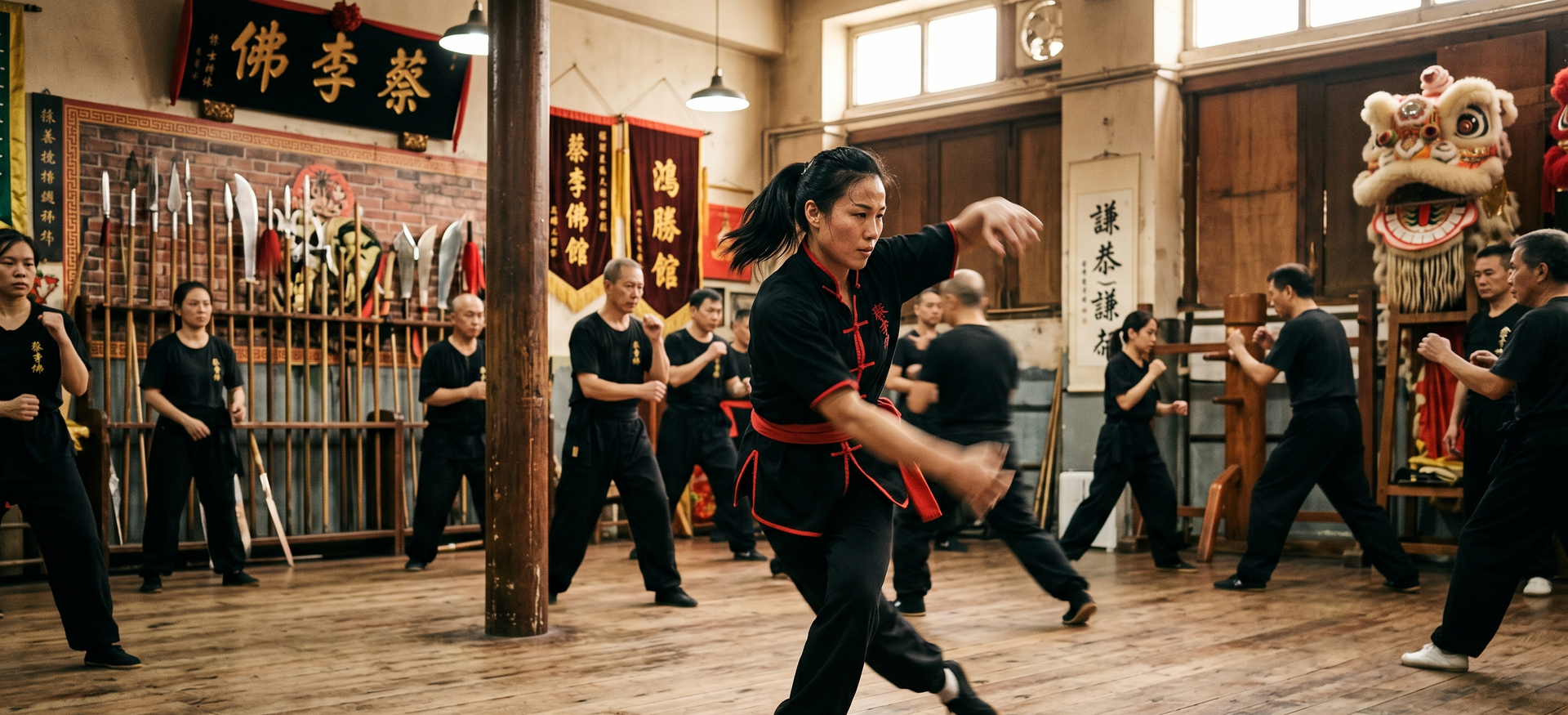
Choy Li Fut — Cai Li Fo in Mandarin — occupies a distinctive place in the landscape of Chinese martial arts. Founded in 1836 by Chan Heung in the Pearl River Delta region of Guangdong Province, it is one of the youngest of the major southern Chinese systems, yet it is also one of the most comprehensive. Chan Heung synthesised his training under three masters — each representing a different stylistic tradition — into a system that deliberately bridges the power and stance work of southern Chinese martial arts with the circular, long-range techniques more commonly associated with northern styles.
The name itself tells the story: Choy refers to the system of Master Choy Fook, Li to the system of Master Li Yau-San, and Fut (Buddha) honours the Shaolin Buddhist heritage transmitted through Chan Heung's uncle, Chan Yuen-Wu. This deliberate synthesis is not mere eclecticism — it reflects Chan Heung's intention to create a complete system combining the best attributes of each tradition.
The Long Bridge Principle
One of the most immediately recognisable aspects of Choy Li Fut is its use of long-range, extended techniques — what practitioners refer to as 'long bridge' fighting. Unlike the close-range, short-power emphasis of many other southern systems such as Wing Chun or Hung Ga, Choy Li Fut frequently extends the arms fully, generating power through circular, sweeping movements that use the full reach of the practitioner.
This long-bridge approach has several strategic implications:
- Range management becomes central — Choy Li Fut practitioners are trained to control the distance of engagement, using their extended reach advantage to strike from ranges where shorter-bridge opponents cannot effectively reach them.
- Circular power generation — the extended, circular strikes of Choy Li Fut generate force through rotation of the waist and hips, with power amplified by the length of the 'arc' through which the technique travels. A practitioner who has developed this mechanism correctly generates remarkable striking power without the need for great muscular size.
- Combination striking — Choy Li Fut is famous for its flowing, multi-technique combinations. The circular mechanics of the system make it natural to chain techniques together, with each strike setting up the next through momentum and positional advantage.
The Distinctive Hand Techniques
Choy Li Fut has one of the richest and most varied hand technique repertoires of any Chinese martial arts system. Students encounter a vocabulary of strikes that extends well beyond the basic straight punch and palm strike common to most systems:
- Sao Chui (sweeping punch) — a horizontal, circular punch using the back of the fist, delivered in a sweeping arc to the head or ribs
- Kup Chui (downward hammer fist) — an overhand hammering strike using the bottom of the fist
- Gwa Chui (backfist) — a circular backfist strike
- Sow Chui (horizontal elbow) — a powerful horizontal elbow technique
These techniques, delivered through the system's characteristic circular mechanics, give Choy Li Fut practitioners an arsenal that is simultaneously diverse and coherent — each technique arising from the same underlying principles of rotation and circular power.
The Forms Curriculum
Choy Li Fut has one of the largest forms curricula of any Chinese martial arts system — some lineages teach dozens of forms — reflecting its ambition as a comprehensive system. Key forms include the foundational introductory sets that develop basic techniques and stances, intermediate forms building the circular striking repertoire, advanced tiger and horse sets developing power and conditioning, and a substantial weapons curriculum including the staff, broadsword, spear, and double swords.
The breadth of the Choy Li Fut curriculum means that serious study rewards long-term commitment. Practitioners often find that forms they learned years earlier reveal new layers of meaning as their understanding of the underlying principles deepens. This is a system that rewards patient, exploratory practice.
Lion Dance and Cultural Practice
Choy Li Fut has historically maintained a particularly strong connection to the Chinese cultural tradition of lion dance. Many Choy Li Fut schools — particularly those with roots in the Cantonese community — continue to practise traditional lion dance alongside their martial arts training. For students interested in Chinese cultural heritage as well as martial arts, this connection offers an additional dimension of engagement with the tradition.
Choy Li Fut in Australia
Australia has a significant Choy Li Fut community, concentrated particularly — though not exclusively — in cities with established Cantonese-Australian communities. Schools in Sydney, Melbourne, and Brisbane have maintained direct lineage connections to the Hong Kong and Guangdong branches of the system, and the standard of instruction in the best of these schools is genuinely high.
For students considering Choy Li Fut, the combination of physical dynamism, extensive technique variety, and the opportunity for long-term depth of study makes it a particularly rewarding choice. It is well suited to students who enjoy variety in their training, who are drawn to the circular and dynamic character of the system's techniques, and who want a traditional Chinese martial arts experience with a strong cultural dimension.