Tai Chi Explained
Internal Strength, Flowing Movement, and the Art of Mindful Practice
More Than a Park Exercise
Walk through any park in Sydney, Melbourne, or Brisbane in the early morning and you are likely to see a group of people moving through Tai Chi practice — slow, flowing sequences performed with an unhurried grace that stands in stark contrast to the pace of modern life around them. For many observers, Tai Chi appears to be primarily a gentle exercise for older adults, a kind of moving meditation with little obvious martial relevance.
That impression, while understandable, significantly underestimates what Tai Chi actually is. Properly understood and practised, Tai Chi Chuan — the full name, meaning Supreme Ultimate Fist — is a sophisticated internal martial art, a profound health cultivation practice, and a philosophical system that offers genuine depth to practitioners at every stage of life. At Martial Arts Australia, we include Tai Chi within our club directory precisely because it represents one of the richest traditions in the entire martial arts spectrum.
Origins and Philosophical Foundations
Tai Chi's origins are traditionally attributed to the semi-legendary Zhang Sanfeng — a Taoist monk who is said to have developed the system based on observations of a fight between a crane and a snake, each using yielding and circular motion to neutralise the other's force. The historical record is considerably more complex, with serious scholars identifying the Chen family of Chenjiagou village, Henan Province, as the more documentable origin point in the 17th century.
What is beyond dispute is that Tai Chi draws deeply from Taoist philosophy — specifically the concepts of yin and yang, the flowing nature of change described in the I Ching, and the Taoist understanding of cultivating, directing, and conserving vital energy (qi). These philosophical foundations are not decorative additions to the fighting system — they are integrated into every aspect of the practice, from how force is generated to how the practitioner approaches health, ageing, and the cultivation of inner calm.
The Major Styles
Contemporary Tai Chi practice is divided among several major family lineages, each with distinct characteristics:
- Chen Style — the oldest and most directly martial of the main styles. Chen Tai Chi alternates between slow, flowing movements and explosive bursts of power called fa jin, and maintains clear combat applications throughout its forms. It is the most physically demanding of the major styles and is the origin from which all other styles descend.
- Yang Style — the most widely practised Tai Chi style globally. Developed in the 19th century by Yang Luchan, who studied from the Chen family and modified the system for broader accessibility, Yang style features large, open movements performed at an even, unhurried pace. The slow practice of Yang style forms is the image most people have when they think of Tai Chi.
- Wu Style — a more compact, internally focused style known for its subtle weight shifting and emphasis on fine refinement of internal principles.
- Sun Style — a relatively modern synthesis incorporating elements of Bagua and Xinyi alongside Tai Chi principles, notable for its lively stepping methods and health cultivation emphasis.
The Health Evidence
Tai Chi is one of the most extensively researched traditional movement practices in the world, with a substantial and growing body of peer-reviewed research documenting its health benefits. The evidence is particularly strong in several areas:
- Balance and fall prevention — consistent Tai Chi practice significantly improves balance and reduces fall risk in older adults, making it one of the most evidence-supported interventions for healthy ageing.
- Cardiovascular health — regular Tai Chi practice improves cardiovascular conditioning, blood pressure management, and aerobic capacity, particularly in populations that cannot engage in higher-intensity exercise.
- Mental health — multiple studies have documented improvements in markers of anxiety, depression, and psychological wellbeing among regular Tai Chi practitioners.
- Cognitive function — emerging research suggests regular Tai Chi practice may support cognitive function and potentially reduce the risk of cognitive decline in older adults.
These benefits are not theoretical — they represent documented outcomes from clinical trials and observational studies conducted across multiple countries and populations. For students who come to Tai Chi primarily for health reasons, the evidence base for their choice is solid.
Tai Chi as a Martial Art
The martial dimension of Tai Chi — the dimension that justifies its inclusion in any serious discussion of martial arts — is real, though it requires serious and sustained practice to develop. The fundamental combat principle of Tai Chi is the use of softness, sensitivity, and redirection to neutralise and counter force, rather than meeting force with force.
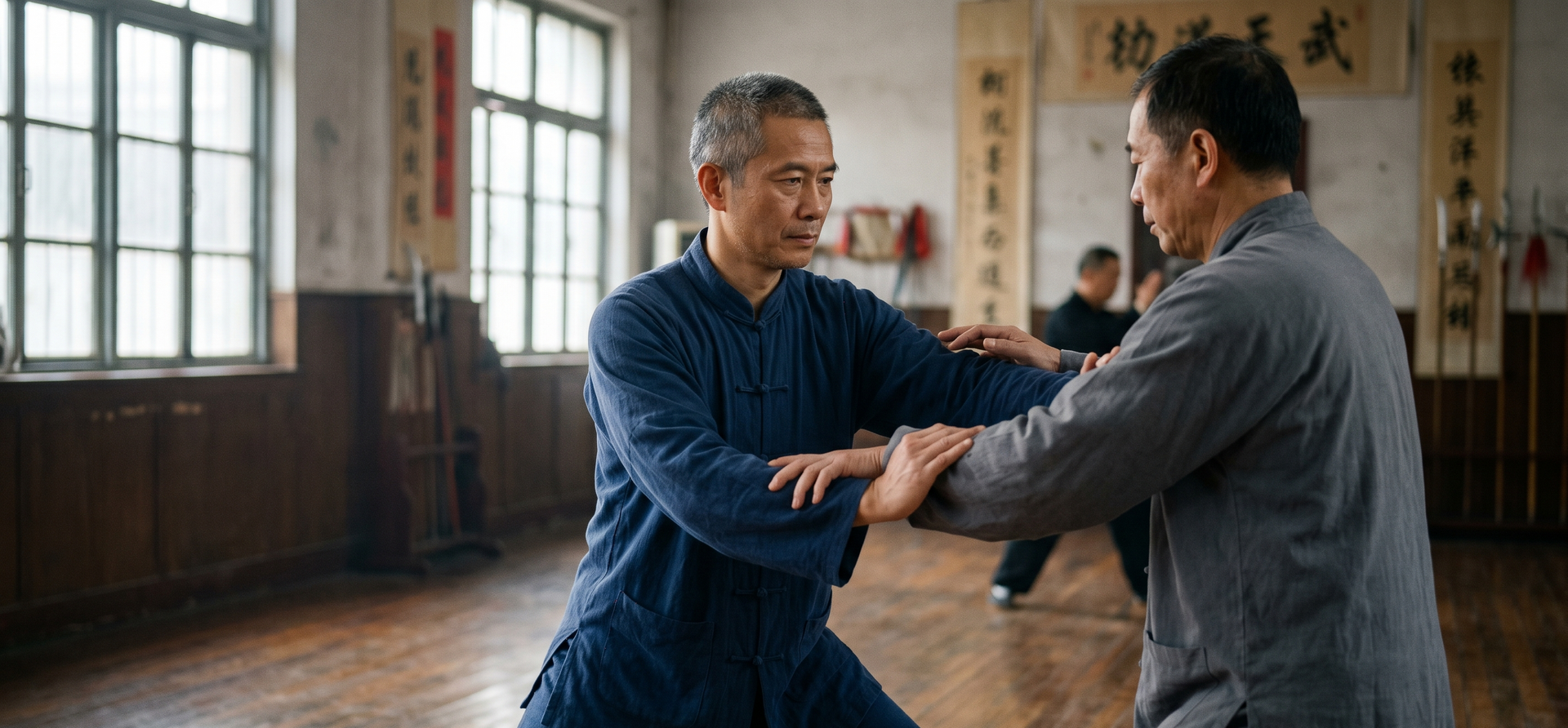
Pushing Hands (Tui Shou) is the primary partner practice that develops the martial dimension of Tai Chi. Two practitioners maintain contact through their arms and practise sensing, redirecting, and uprooting each other's balance using the sensitivity and structural principles developed in solo form practice. Advanced Pushing Hands work develops a quality of integrated, whole-body responsiveness that is both genuinely effective and deeply interesting to explore.
Finding the Right Tai Chi School
The diversity of Tai Chi instruction in Australia ranges from excellent to poor, and the lack of universal credentialing standards means that prospective students need to exercise some discernment. Look for instructors who can clearly articulate the principles behind the movements and not merely demonstrate the choreography, who teach Pushing Hands alongside forms, and who can discuss the martial applications of the system as well as the health aspects.
Martial Arts Australia's club directory includes Tai Chi schools whose instructors have established credentials and genuine depth of knowledge. We encourage you to use the directory as your starting point for finding quality instruction.