Wushu Explained
Athletic Excellence, Artistic Precision, and the Modern Face of Chinese Martial Arts
Wushu occupies a unique position in the martial arts world. It is simultaneously one of the most visually spectacular disciplines in all of sport and a source of genuine technical controversy — celebrated by its practitioners as the highest expression of Chinese martial arts athleticism, and critiqued by traditionalists as a departure from the combat-focused roots of the systems it draws from. Understanding Wushu clearly means understanding both what it is and what it is not.
At Martial Arts Australia, we work with practitioners across the full spectrum of Chinese martial arts, and we believe Wushu deserves to be understood and appreciated on its own terms — as a discipline that has developed genuine excellence in its chosen direction, independent of whether that direction aligns with every practitioner's priorities.
The Development of Modern Wushu
Modern Wushu — sometimes distinguished as 'contemporary Wushu' to separate it from the broader historical term — emerged as a formal sport discipline in China following the establishment of the People's Republic in 1949. The Chinese government sought to standardise and preserve the diverse martial arts traditions of the country while making them accessible for physical education and international representation. The result was a codified sport system that drew from a wide range of traditional Chinese martial arts styles, extracting and amplifying their most visually impressive elements.
By the 1970s and 1980s, Wushu had developed into a competitive sport with defined categories, judging criteria, and international governing bodies. The first World Wushu Championships were held in 1991, and Wushu has been a demonstration or exhibition sport at multiple Asian Games and regional multi-sport events, with ongoing efforts to achieve full Olympic inclusion.
The Two Pillars: Taolu and Sanda
Modern Wushu is structured around two primary competitive disciplines:
Taolu — Forms Competition
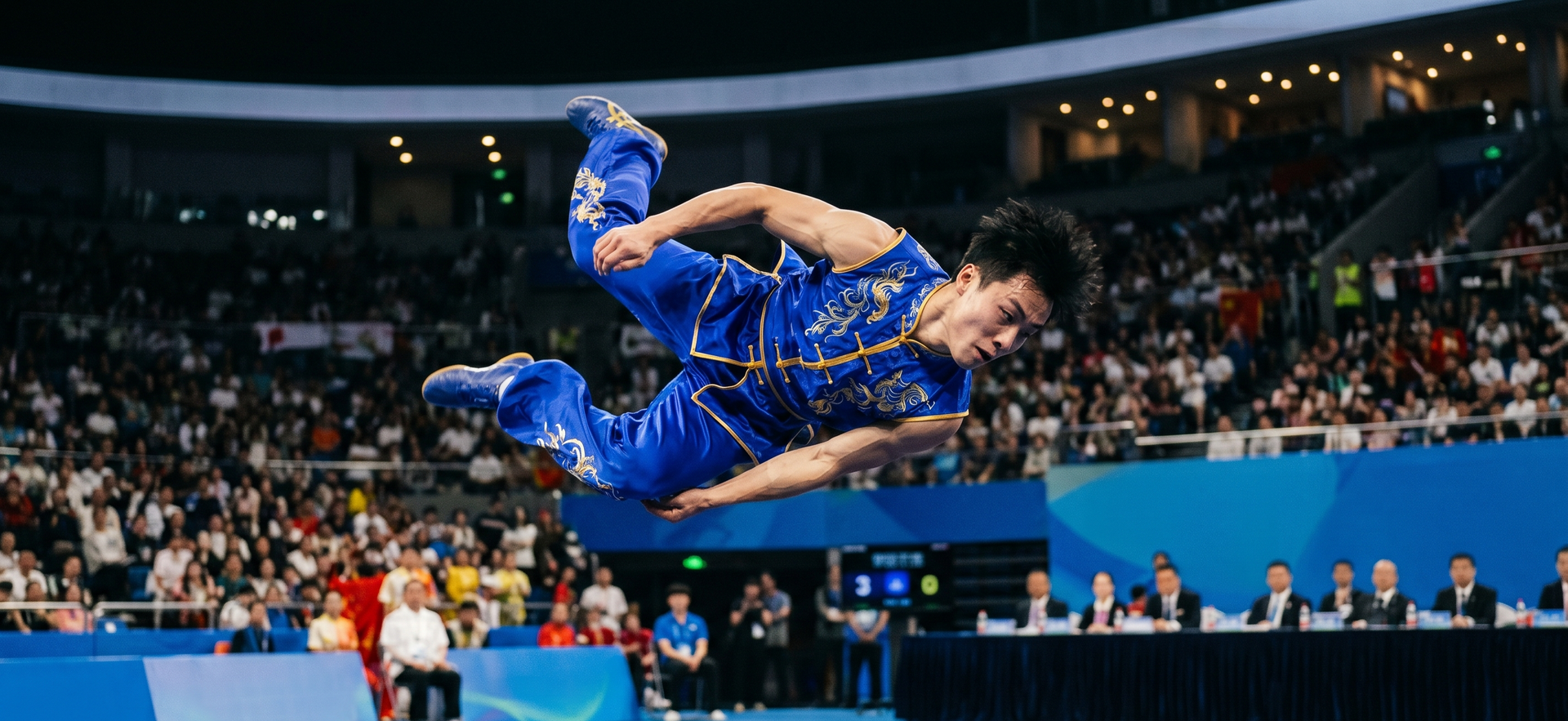
Taolu is the forms performance component of Wushu competition. Competitors perform choreographed sequences — drawn from standardised modern forms or from traditional style forms — and are judged on technical execution, difficulty, athletic quality, and presentation. The movements are taken from a range of traditional Chinese martial arts styles, including Changquan (Long Fist), Nanquan (Southern Fist), Taijiquan, and weapon disciplines including the staff, broadsword, straight sword, and spear.
What makes elite Taolu genuinely impressive is the integration of extreme athletic demands — acrobatic jumping kicks, spinning aerial techniques, rapid transitions between high and low positions — with precise technical execution and graceful, flowing connection between movements. An elite Wushu Taolu competitor is combining the physical capabilities of a gymnast, the precision of a dancer, and the martial vocabulary of a highly trained traditional martial artist.
Sanda — Combat Competition
Sanda (also known as Sanshou) is the competitive fighting component of Wushu. It is a full-contact striking and throwing discipline combining punches, kicks, and takedowns — specifically Chinese wrestling-style throws called shuai jiao. Sanda is a genuinely demanding combat sport that has produced elite fighters who have competed successfully in kickboxing, MMA, and other striking disciplines at the international level.
While Sanda receives less international attention than Taolu, it is the component of Wushu that most directly tests combat effectiveness. Chinese Sanda competitors are among the most technically proficient striking athletes in the world.
The Traditional Dimension: Wushu as a Gateway
One of Wushu's most significant contributions to the martial arts landscape has been its role as a gateway to the broader Chinese martial arts tradition. The standardised modern forms taught in Wushu are derived from specific traditional styles — Changquan from northern long-fist systems, Nanquan from southern styles — and many practitioners begin their Chinese martial arts journey through Wushu before finding their way to the traditional systems that interest them most.
Wushu training develops attributes — body conditioning, coordination, flexibility, aerial capability, and a kinesthetic vocabulary of Chinese movement principles — that transfer meaningfully to traditional practice. Many serious traditional practitioners have recognised this, and the relationship between competitive Wushu and traditional Chinese martial arts is considerably more collaborative than the sometimes heated public debate suggests.
What Wushu Training Involves
At the competitive level, Wushu training is among the most physically demanding in all of martial arts. The acrobatic elements of competitive Taolu require dedicated flexibility and strength training, extensive conditioning for the explosive jumping and spinning techniques, and years of patient form practice to achieve the precision and flow that judges reward.
At the recreational and community level, Wushu training offers a structured introduction to Chinese martial arts movement that is genuinely accessible to beginners. The standardised forms are well-documented, well-taught through international instructor certification programs, and provide clear progression benchmarks for students.
Children take to Wushu extremely well — the combination of physical challenge, visible skill development, and the opportunity for performance and competition creates a highly engaging training experience that builds confidence, coordination, and discipline.
Wushu in Australia
Australia has been represented at international Wushu competition for decades, with Australian athletes competing at World Championships and regional events across both Taolu and Sanda categories. State Wushu federations operate in most major states, and the national body works with Australian Olympic Committee frameworks while pursuing pathway programs for elite competitors.
At the community level, Wushu schools operate across the country, many of them within Chinese-Australian community organisations that also maintain traditional martial arts programs. For students interested in Chinese martial arts, Wushu represents an excellent starting point.