Hapkido and Aikido: The Redirection Arts and the Philosophy of Non-Resistance
How Two Traditions Built Around Yielding and Joint Control Became Complete Martial Systems
Of all the ideas that martial arts have contributed to human culture, perhaps none is more counterintuitive or more enduring than this: you do not need to be stronger than your opponent. You need only to use their strength better than they do.
This principle — the redirection of force rather than the meeting of it — is the philosophical and technical heart of two of the most sophisticated defensive arts ever developed: Hapkido from Korea and Aikido from Japan. They share a common ancestral root in Japanese Daito-ryu Aiki-jujutsu, yet they evolved into remarkably distinct systems, each expressing the redirection principle through its own cultural lens and technical vocabulary.
The Shared Root: Daito-Ryu Aiki-Jujutsu
Understanding Hapkido and Aikido requires a brief detour into their common ancestor. Daito-ryu Aiki-jujutsu is a classical Japanese martial art attributed to the Minamoto clan, formalised in the late nineteenth and early twentieth centuries by Sokaku Takeda. It is a comprehensive system of joint locks, throws, and strikes designed for the battlefield and for close-quarters defence, emphasising the principle of 'aiki' — the harmonisation of energy with an opponent's movement to control or destroy their balance before applying technique.
Two of Takeda's most influential students would take this art in very different directions. Morihei Ueshiba, a Japanese martial artist and spiritual seeker, transformed Daito-ryu into what he named Aikido — incorporating deep philosophical and spiritual dimensions. Choi Yong-sool, a Korean who trained under Takeda's system, returned to Korea after World War Two and developed what eventually became Hapkido, integrating Korean kicking traditions and creating a more explicitly combative and self-defence-oriented system.
Aikido: The Way of Harmonious Energy
Morihei Ueshiba — known within the Aikido world simply as 'O-Sensei' (Great Teacher) — was one of the most remarkable martial artists of the twentieth century. By multiple accounts, his physical ability was extraordinary: smaller practitioners describe being thrown by him with a force and ease that defied ordinary explanation. More remarkably, he underwent a profound spiritual transformation in midlife that redirected the purpose of his martial practice away from victory over others toward harmony and the protection of all parties, including attackers.
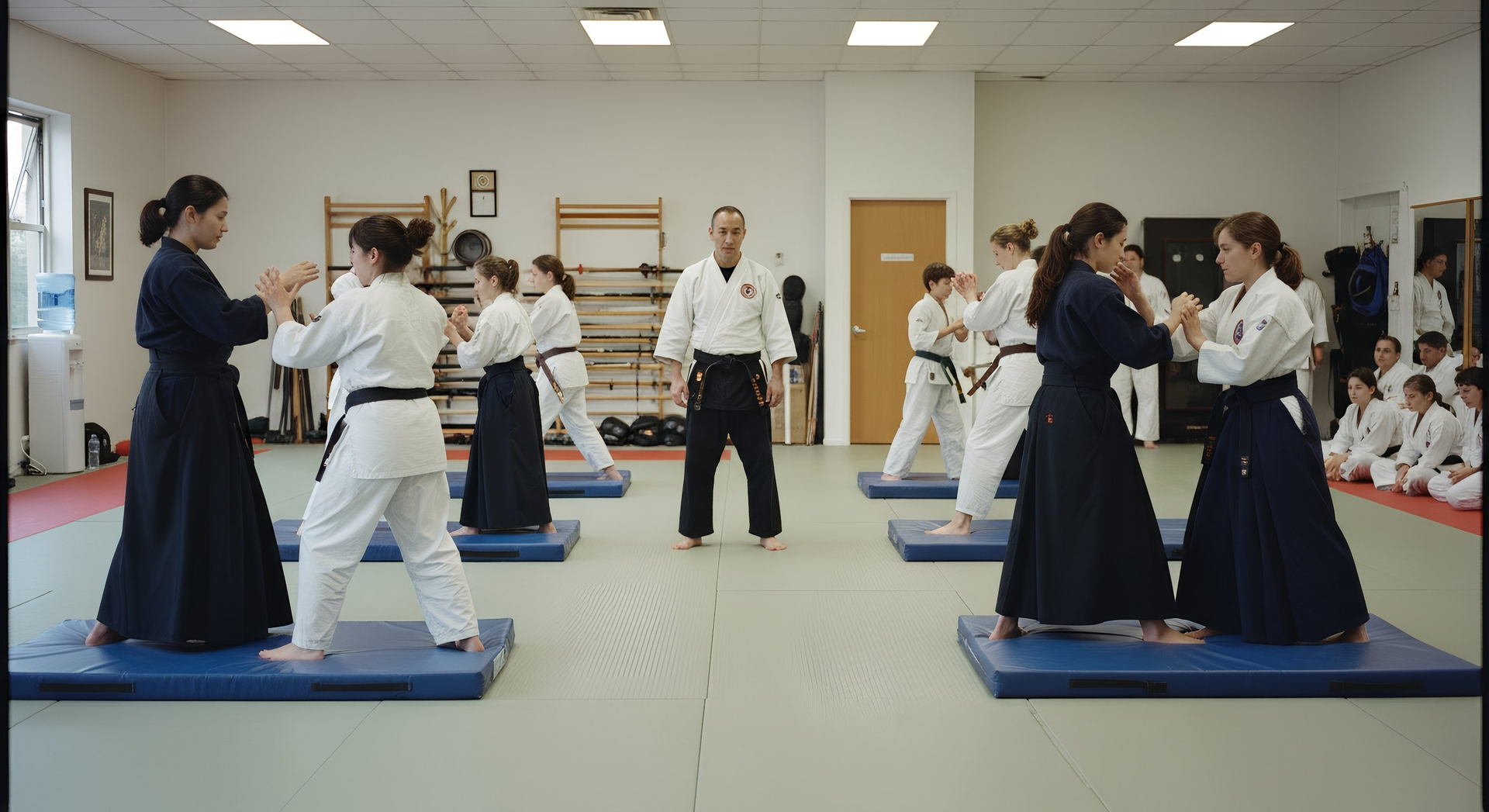
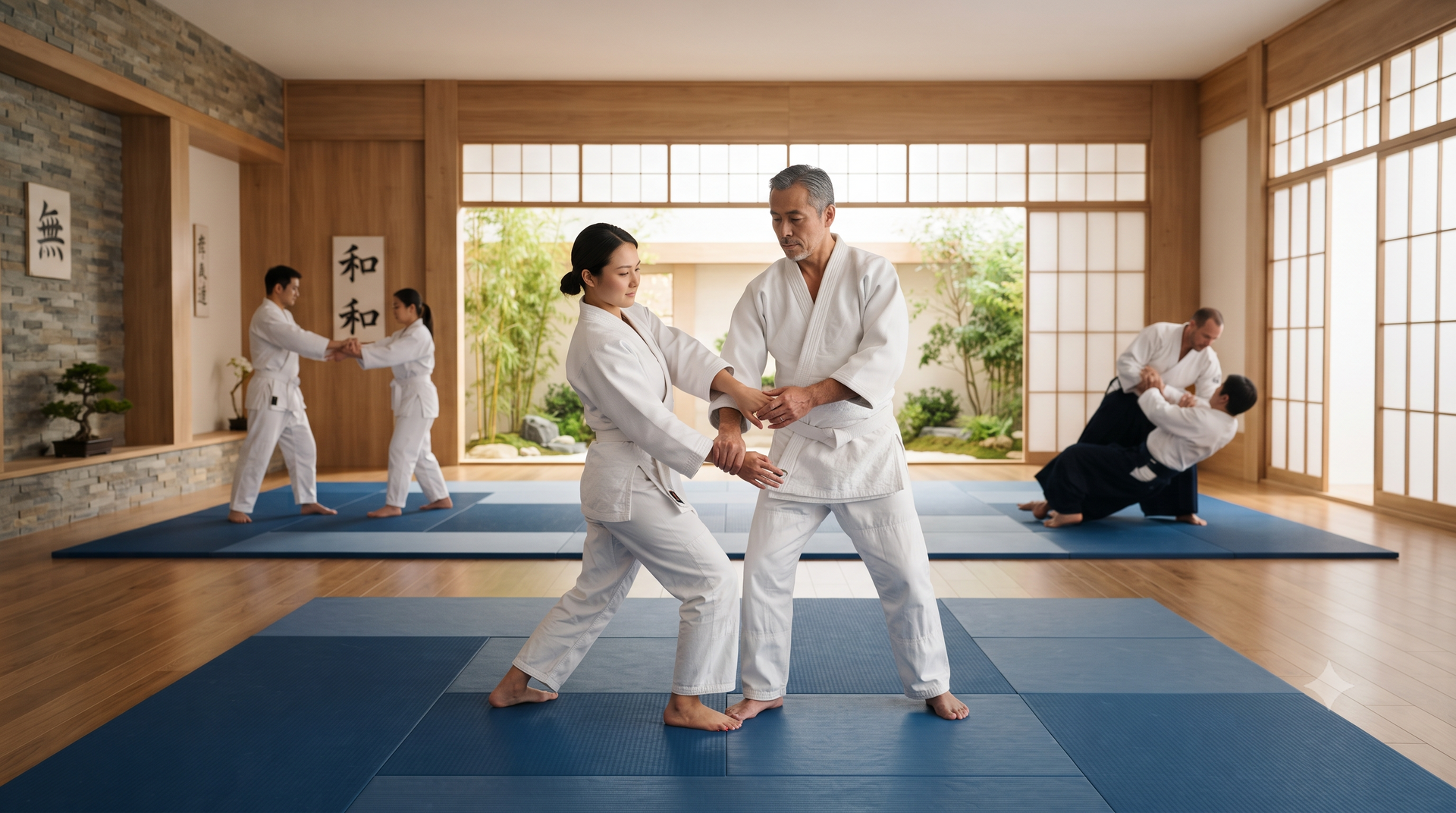
This philosophy is embedded in Aikido's technical structure. Aikido techniques — irimi-nage (entering throw), tenchi-nage (heaven-and-earth throw), kote-gaeshi (wrist turn), and the numerous variations of ikkyo, nikyo, sankyo, and yonkyo joint controls — are designed to redirect an attacker's force rather than block or absorb it, and then to neutralise the attack through a throw or joint lock that ideally injures neither party. The practitioner moves not against the attack but with it — blending, redirecting, and then controlling.
The philosophical dimension of Aikido sets it apart from virtually every other martial art. O-Sensei explicitly described Aikido as a path to universal peace — not a fighting system but a method of reconciliation expressed through movement. This has made Aikido a frequent subject of debate within the martial arts community, because it also means that traditional Aikido does not include competitive sparring. Practitioners cannot 'test' their technique against a fully resisting opponent in the way that judo or BJJ practitioners do.
This debate is real and worth acknowledging. Some Aikido schools have addressed it by incorporating more 'alive' training — pressure testing techniques against partners who offer genuine resistance. Others maintain the traditional approach, arguing that the art's value lies in the quality of the internal development it produces, not in competitive outcomes. Both positions have merit, and prospective students should be aware of this distinction when choosing a school.
Australia has a strong Aikido community, with affiliated dojos across every state. The Aikikai — the organisation founded by O-Sensei's lineage — maintains the largest presence, though Yoshinkan Aikido (a more physically demanding and structured variant) and Ki Aikido (emphasising the internal energy aspects) also have active Australian organisations.
Hapkido: The Way of Coordinated Power
Where Aikido is flowing, philosophical, and frequently described as 'beautiful,' Hapkido is more direct, more explicitly combative, and technically broader in scope. Its name — 'the way of coordinated power' — signals a focus on efficient energy coordination rather than harmony as an end in itself.
Hapkido's technical range is one of its most impressive characteristics. The joint lock and throwing repertoire is enormous — arguably the most comprehensive in any unarmed martial art — covering every joint in the body from the fingers to the ankles with specific techniques designed to control, direct, or damage depending on context. These are combined with an extensive kicking arsenal — including jumping, spinning, and low-line kicks — and a complete striking system that makes Hapkido genuinely comprehensive as a stand-alone self-defence system.
The three principles that govern Hapkido technique are: hwa — harmony or yielding; won — circular motion; and yu — flow or water principle. These principles dictate that the practitioner never meets force head-on, always redirects through circular movement, and moves with the fluidity of water — taking the shape of whatever container it occupies. Applied to combat, this means moving around and through an attacker's force rather than blocking it, and using the attacker's own committed energy against them.
Hapkido has a particularly strong reputation in law enforcement and military circles, where the ability to restrain and control without necessarily causing serious injury has clear practical value. Several Australian police forces and security organisations have incorporated elements of Hapkido into their defensive tactics training. This practical application pedigree gives Hapkido a credibility in self-defence circles that is backed by real-world testing.
Comparing the Two: Complementary, Not Competing
Despite their shared ancestry, Aikido and Hapkido present quite different training experiences and attract somewhat different practitioner profiles. Aikido tends to attract practitioners drawn to philosophical depth, elegant movement, and a non-competitive training environment. Hapkido tends to attract practitioners seeking comprehensive self-defence capability with clear practical application.
What they share, beneath these differences, is more fundamental than what distinguishes them. Both arts teach the practitioner to move from a calm, centred state rather than a reactive, panicked one. Both develop extraordinary sensitivity to balance — the ability to feel another person's centre of gravity through the point of contact and to manipulate it precisely. And both are built on the insight that genuine power comes not from muscular force but from the alignment of intention, structure, and timing.
For the practitioner already training in a striking art, adding either Hapkido or Aikido produces remarkable results. The joint-lock vocabulary provides options in the close-quarter range that striking arts rarely explore. The sensitivity developed through redirection training changes the quality of all physical contact. And the philosophical depth — particularly in Aikido — provides a framework for thinking about what martial arts is ultimately for that transcends any particular technique or competition result.
Finding Your School in Australia
Hapkido and Aikido schools are available across Australia, though the availability varies by region. The Martial Arts Australia club directory is a useful first resource. When evaluating schools, pay attention to the balance between technical training and philosophical discussion — both are important, but neither should completely dominate. Visit before committing, observe a class, and speak with the instructor about their approach to partner training and the pace of progression they recommend for adult beginners.
These are arts that reward patient, consistent study over years. They offer a different kind of martial arts experience than competition-focused or striking-heavy systems — quieter in some ways, more internally demanding in others. For the practitioner whose interest extends beyond winning and into the deeper questions of what it means to move with genuine skill and composure, they are among the most rewarding paths available.