Muay Thai vs Kickboxing: Understanding the Difference and Finding Your Strike Game
Eight Limbs vs Four The Complete Guide to Stand-Up Striking Arts for Australian Practitioners
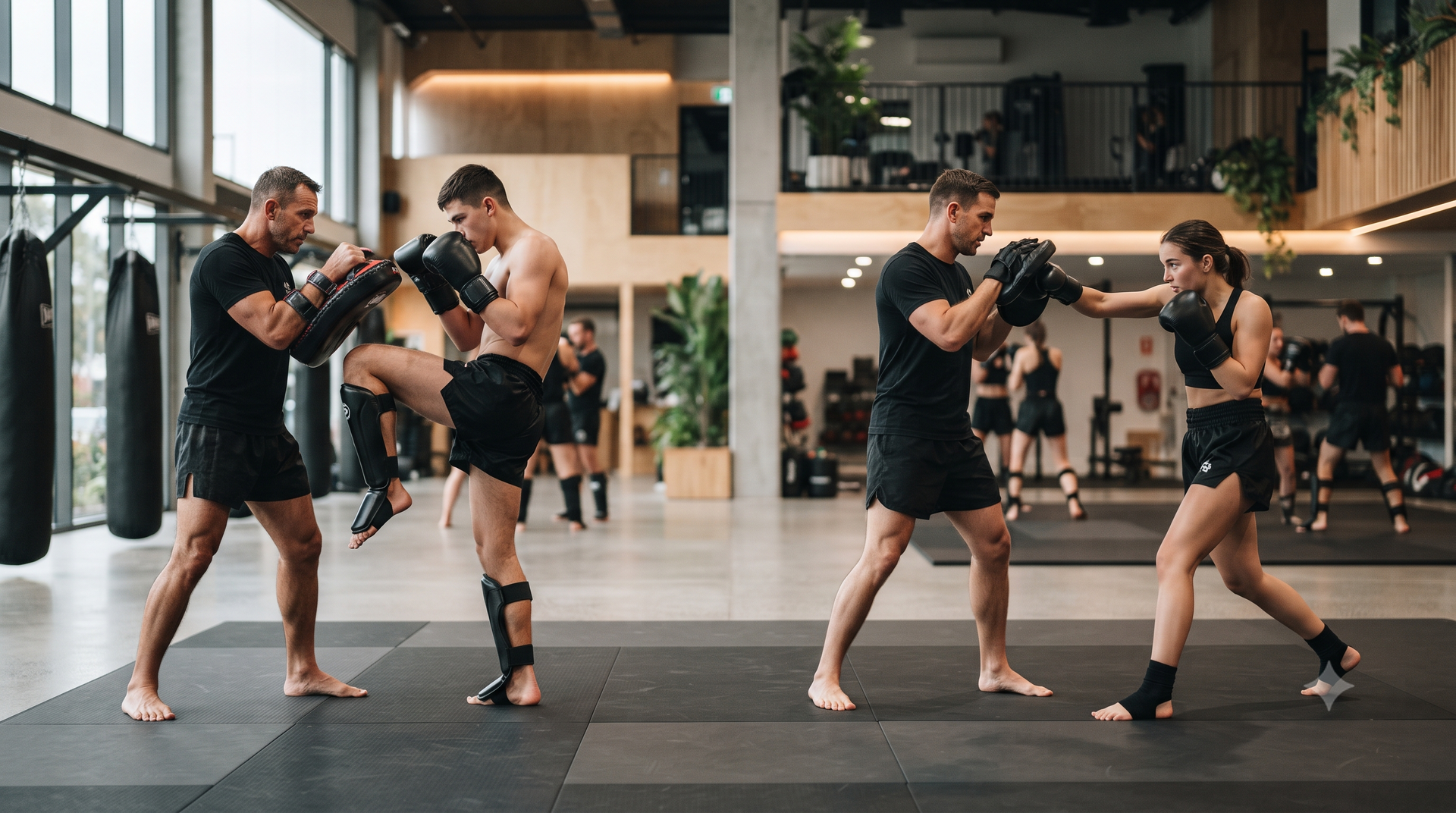
Walk into almost any martial arts gym in a major Australian city and you will find classes for both Muay Thai and Kickboxing. Often they are offered on the same weekly schedule, by the same coaches, using the same equipment. From the outside, they can look almost identical — two people in gloves and shorts exchanging punches and kicks on a heavy bag or in the ring.
Beneath that surface similarity, however, are two genuinely distinct striking systems with different histories, different technical toolkits, different competitive frameworks, and different training cultures. Understanding those differences matters, both for people choosing between them and for practitioners already in one system who are wondering what the other offers.
Muay Thai: The Art of Eight Limbs
Muay Thai — the national martial art of Thailand — is often called the 'art of eight limbs' because it deploys two fists, two elbows, two knees, and two shins as primary weapons, in addition to sophisticated clinch-work that would be prohibited in most Kickboxing rule sets. This eight-limb framework makes Muay Thai one of the most comprehensively dangerous stand-up striking systems ever developed.
The history of Muay Thai stretches back centuries in Thai military and cultural tradition, formalised into its modern sporting form in the twentieth century with the establishment of Rajadamnern and Lumpinee stadiums in Bangkok as premier competition venues. Thai fighters begin training from childhood, often in residential camps that combine extreme physical conditioning with high-volume technical drilling. By the time a Thai professional reaches their competitive prime, they typically have hundreds of fight appearances.
The technical sophistication of Muay Thai goes far beyond the obvious additional weapons. The stance is distinctive — typically more upright than Western boxing, with hands carried higher to protect against elbows and the head, and with the lead leg turned outward to facilitate defensive leg checks (using the shin to intercept incoming kicks). The clinch — the 'plum' or double collar tie — is a controlled inside-range position from which Thai fighters deliver devastating short knees to the body and head, elbows in close, and throw opponents off balance through sweeps and trips.
The shin conditioning that Muay Thai develops is a subject of significant interest outside the art. Thai fighters and serious Muay Thai practitioners develop shin bones that, through repeated low-grade impact, increase in density significantly above baseline. This is not mystical — it is Wolff's Law, the well-documented physiological principle that bone adapts to repeated loading by increasing density along stress lines. A conditioned Muay Thai shin is a genuinely different instrument than an unconditioned one.
In Australia, Muay Thai has exploded in popularity over the past fifteen years. High-quality gyms with authentic Thai coaching are present in every major city. The ONE Championship, Australia's biggest MMA and Muay Thai promotion, has brought international-level Thai boxing to Australian audiences and created a new generation of serious practitioners and competitors.
Kickboxing: The Hybrid Striking Art
Kickboxing is a broader, more varied term than Muay Thai. Depending on context, it refers to several overlapping but distinct systems — American Kickboxing, Japanese Kickboxing (K-1 rules), Dutch-style Kickboxing, and Full Contact Karate. What they share is a framework that combines boxing's hand techniques with kicking, but without Muay Thai's elbows, knees, and clinch work.
American Kickboxing, which emerged in the 1970s, was largely an American sporting response to traditional Karate's non-contact or light-contact competition formats. Promoters recognised that audiences wanted to see full-contact striking, and American Kickboxing — initially derived from Karate with boxing gloves and full-power techniques added — filled that gap. Its technical range is more limited than Muay Thai: punches and kicks above the waist are the primary tools, with no elbows, knees, or clinch fighting permitted.
K-1 rules Kickboxing — popularised in Japan in the 1990s through the K-1 Grand Prix promotion — is a richer technical system. It permits punches, kicks, and knee strikes (though knee strikes in the clinch are more restricted than in Muay Thai), creating a competition format that attracted the world's best strikers from multiple fighting disciplines. The K-1 era produced some of the most technically brilliant and exciting stand-up fighters the world has seen, including Ernesto Hoost, Peter Aerts, and Mirko Cro Cop.
Dutch-style Kickboxing, associated with training camps in Amsterdam, is arguably the most technically sophisticated version of the Western kickboxing tradition. Dutch coaches developed a synthesis of boxing footwork and combination work with powerful kicking, emphasising aggressive combination attack and high-level defensive skills that have produced a stream of elite fighters over several decades.
Technical Differences: What Changes Between the Systems
The practical differences between Muay Thai and Kickboxing show up clearly in several areas. Footwork is one of the most visible. Kickboxing — particularly Dutch and American styles — emphasises active, boxing-influenced footwork: angling, circling, in-and-out movement designed to create offensive opportunities and defensive angles. Traditional Muay Thai footwork is more measured — Thai fighters are trained to be stable and rooted, comfortable exchanging at mid-range, with movement used more selectively.
Combination structure is another area of divergence. Kickboxers, influenced by boxing's combination tradition, often train longer punching combinations — jab-cross-hook-cross, jab-body-head, and so on. Muay Thai combinations are typically shorter and designed around the threat of the elbow and knee in close range, which changes the tactical calculus of exchange.
The clinch is perhaps the most decisive technical difference. A Muay Thai fighter who can neutralise a Kickboxer's punching range by entering the clinch has access to a devastating arsenal of knees and elbows that the Kickboxing rule set simply does not prepare fighters to defend. Conversely, Kickboxing's active footwork and combination volume can frustrate a Muay Thai fighter who relies on measured countering rather than active combination attack.
Which Should You Choose?
For the student purely focused on self-defence, Muay Thai's broader arsenal — including clinch fighting, knees, and elbows — provides more technical tools for more common real-world scenarios. The clinch in particular is where most real confrontations spend significant time, and having training there is a meaningful practical advantage.
For the student primarily interested in fitness, both systems offer exceptional conditioning. Muay Thai's clinch drilling adds a distinctive upper-body resistance component. Kickboxing's combination-heavy approach tends to produce higher volume output in shorter training windows. Either will transform your conditioning over time.
For the student interested in competition, the choice depends on which competitive framework appeals. Muay Thai in Australia has a well-structured amateur and professional competition circuit through organisations like the World Thai Boxing Association. Kickboxing competition in Australia is diverse — from amateur full-contact events to professional K-1 style shows. Research what is active in your region.
For most students who choose one and train it seriously for a year or two, the recommendation from most coaches is the same: visit the other system eventually. A Muay Thai practitioner who understands boxing combination structure becomes more dangerous. A Kickboxer who understands clinch fighting becomes far harder to neutralise. The two systems are complementary in ways that reward cross-training.
Finding the Right Gym in Australia
Australia has excellent Muay Thai and Kickboxing coaching, with many gyms able to offer both. When evaluating striking gyms, look for coaches who can articulate the technical differences between the systems, provide appropriate protective equipment for beginners, and have a clear structure for safe sparring progression. The Martial Arts Australia directory includes striking arts clubs across the country, and MAA-affiliated clubs have committed to professional coaching standards that provide additional assurance of quality.