The Internal Martial Arts: Tai Chi, Xingyi, and Bagua — Power, Health, and the Art of Not Forcing
Understanding the Chinese Internal Traditions and Why They Reward Patient Study
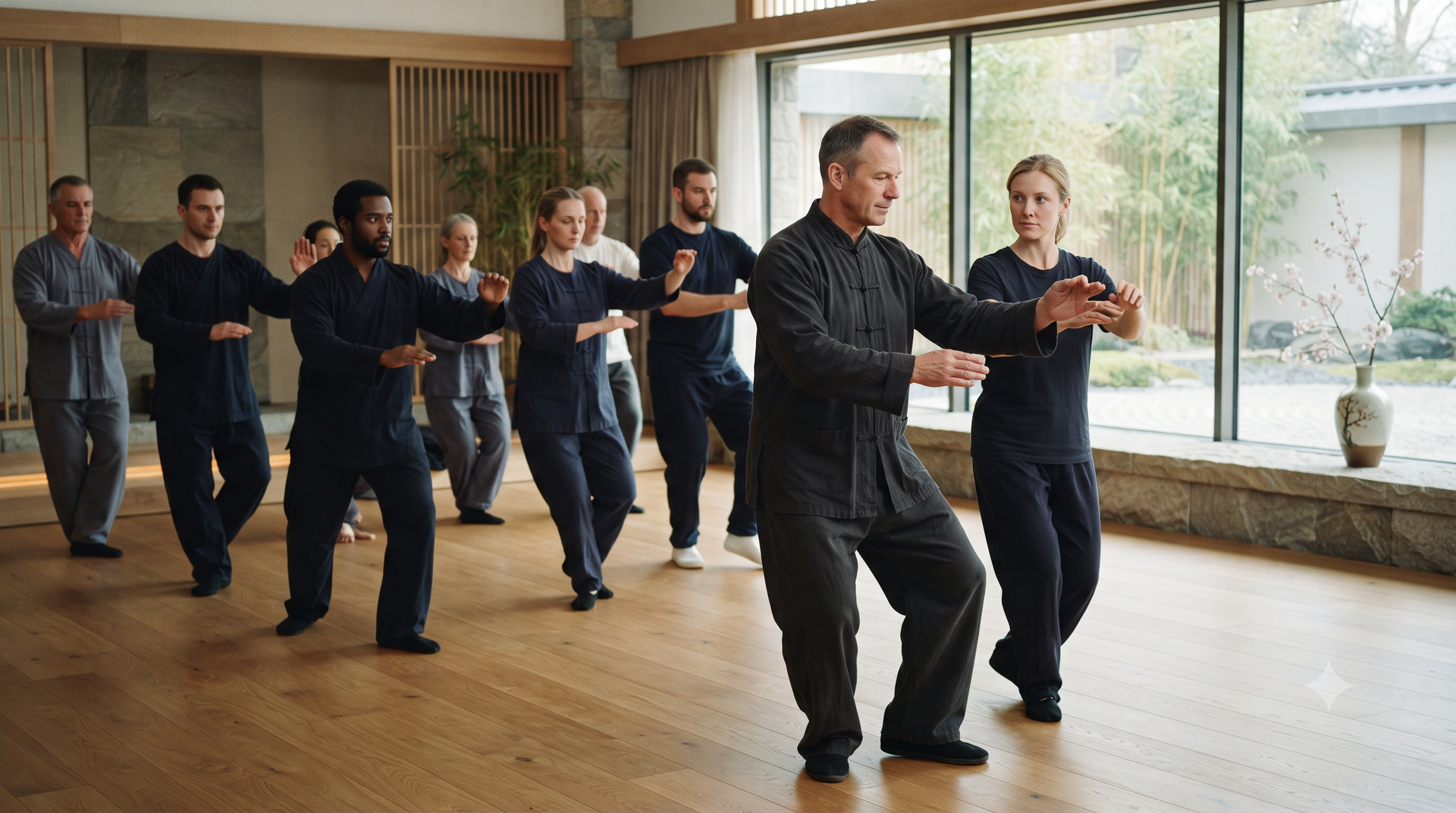
Chinese martial arts are broadly divided into two categories: external (waijia) and internal (neijia). The external arts — Shaolin Kung Fu, Hung Gar, Northern Wushu — develop power primarily through muscular strength and physical conditioning. The internal arts take a different path entirely. They develop power through structural alignment, breath work, relaxation, and the cultivation of what Chinese martial theory calls 'nei jin' — internal energy or internal power.
The internal arts are frequently misunderstood, both by sceptics who dismiss them as mystical nonsense and by uncritical enthusiasts who attribute to them supernatural qualities they do not possess. The truth, as is often the case, is more interesting than either extreme. The internal arts produce real, measurable physical and psychological benefits through mechanisms that are now increasingly explicable in terms of modern physiology and neuroscience. They simply take longer to understand than external arts, which is partly why they are underrepresented in mainstream martial arts conversation.
This article introduces the three principal internal Chinese martial arts — Tai Chi Chuan, Xingyiquan, and Baguazhang — and examines what makes each unique, what they share, and why serious study of any one of them is a genuinely rewarding lifelong practice.
Tai Chi Chuan: The Art the World Got Half Right
Tai Chi Chuan is simultaneously the most famous and the most misunderstood internal art. An estimated 300 million people practise some form of Tai Chi globally, which makes it arguably the world's most widely practised martial art by sheer participation numbers. Yet the vast majority of those 300 million people practise a version of Tai Chi that has been stripped of its martial content — a gentle exercise form disconnected from its origins as a sophisticated fighting system.
Traditional Tai Chi Chuan — particularly in styles like Chen, Yang, Wu, and Sun — is a complete martial arts system built on principles that are challenging to grasp but extraordinary in their application. The foundational principle is 'song' — usually translated as 'relaxation,' though 'releasing unnecessary tension while maintaining structural integrity' is more accurate. The practitioner learns to move without muscular bracing or tension, allowing force to transfer through the skeleton rather than being absorbed by contracted muscles.
The martial implications of this are significant. A fully relaxed body is more sensitive to incoming force than a tense one, because muscle tension creates a form of insulation. The internal practitioner uses this sensitivity to detect and redirect force before it fully arrives — a concept called 'listening energy' (ting jin). What looks like passivity is actually extreme responsiveness.
The health benefits of Tai Chi are among the most extensively researched of any martial art. Meta-analyses of clinical studies show consistent evidence for improvements in balance and fall prevention in older adults, reductions in systolic blood pressure, improvements in sleep quality, and reductions in anxiety and depressive symptoms. The Australian government's health guidelines include Tai Chi as a recommended activity for older Australians specifically because of its fall-prevention evidence base.
For the martial arts student approaching Tai Chi seriously, the advice from virtually every credible teacher is the same: find a school that maintains the martial content alongside the health practice. The movements make complete sense when understood as combat techniques. Without that understanding, the form becomes an exercise routine — still valuable, but a fraction of what it could be.
Xingyiquan: The Internal Art of Explosive Power
If Tai Chi Chuan is the internal art most associated with gentleness and health, Xingyiquan (Hsing-I Chuan) is the internal art that most resembles an external art to the uninformed observer. It is direct, powerful, and at times explosive in a way that surprises people who expect all internal arts to look like slow, flowing movement.
Xingyiquan translates roughly as 'form-mind fist' — a name that captures its essential nature. The 'form' refers to the physical structure of the body, and the 'mind' refers to the practitioner's intent. The art teaches practitioners to align physical structure and mental focus so completely that force generation requires minimal muscular effort. The power feels shocking to receive because it arrives with very little telegraphing — no windup, no obvious muscular tension, just sudden structural compression.
The technical foundation of Xingyiquan is the Five Elements (Wu Xing) — Pi (splitting), Zuan (drilling), Beng (crushing), Pao (cannon), and Heng (crossing) — combined with the Twelve Animal shapes, which represent different tactical and movement qualities rather than literal imitations. The Five Element forms are trained individually as single techniques before being combined into the San Ti Shi (Three Body Posture) — a standing exercise that forms the art's developmental foundation.
Xingyiquan has a particular appeal for practitioners who find the pace of Tai Chi Chuan development too slow, or who want internal principles with more immediately recognisable martial application. Its relatively direct training methodology produces discernible results more quickly than some other internal arts, making it a good entry point into the internal system for students with external arts backgrounds.
Baguazhang: The Art of Constant Change
Baguazhang — 'Eight Trigram Palm' — is the most unusual and perhaps the most technically demanding of the three internal arts. Its signature is the circle walk: practitioners spend a significant portion of training time walking continuously in circles, maintaining a specific postural structure while transitioning between palm changes and linear attacks that emerge from and return to the circular path.
The tactical principle underlying this unusual training method is one of the most sophisticated in all of martial arts: perpetual angular advantage. By keeping an opponent on the outside of a circular movement, the Bagua practitioner continuously presents their strongest angle to their opponent's weakest. The circle walk trains the body to find and maintain this positional advantage automatically, as an ingrained movement habit rather than a consciously calculated strategy.
The palm techniques of Baguazhang are distinctive — most strikes use open-hand palms rather than closed fists, delivering force through the heel of the palm or the fingers. The Eight Mother Palms form the technical core, with each palm associated with one of the trigrams of the I Ching, a classical Chinese text on change and transformation. This philosophical integration is not decorative: the art's central teaching is that the practitioner must be capable of continuous change, never becoming fixed in position, posture, or intention.
Baguazhang teachers in Australia are less common than Tai Chi instructors, but dedicated schools do exist in the major cities. For the practitioner willing to invest in its unusually patient learning curve, it offers technical and conceptual depth that rewards decades of study.
What Unites the Internal Arts
Despite their distinct flavours, the three internal arts share a common philosophical framework. All three emphasise the development of structural integrity over muscular power, sensitivity over brute force, and the efficient use of whole-body mechanics over localised muscle groups. All three treat the training as a process of refining the practitioner as a person — not simply building a more effective fighter.
This is perhaps their most distinctive contribution to the broader martial arts world. While many arts provide excellent physical and mental training, the internal arts maintain an unusually explicit philosophical commitment to the practitioner's personal evolution. The goal of training is not simply to accumulate technique but to fundamentally change the quality of your presence — how you move, how you think, and how you respond to difficulty.
In a martial arts landscape that sometimes prioritises rapid results and measurable outcomes, the internal arts offer a different invitation: to slow down, to pay closer attention, and to discover what happens when you stop forcing.