The Kicking Arts and Your Insurance: What Taekwondo, Capoeira and Savate School Owners Need to Declare
High-Impact, High-Elevation Striking Needs to Be Accurately Reflected in Your Policy
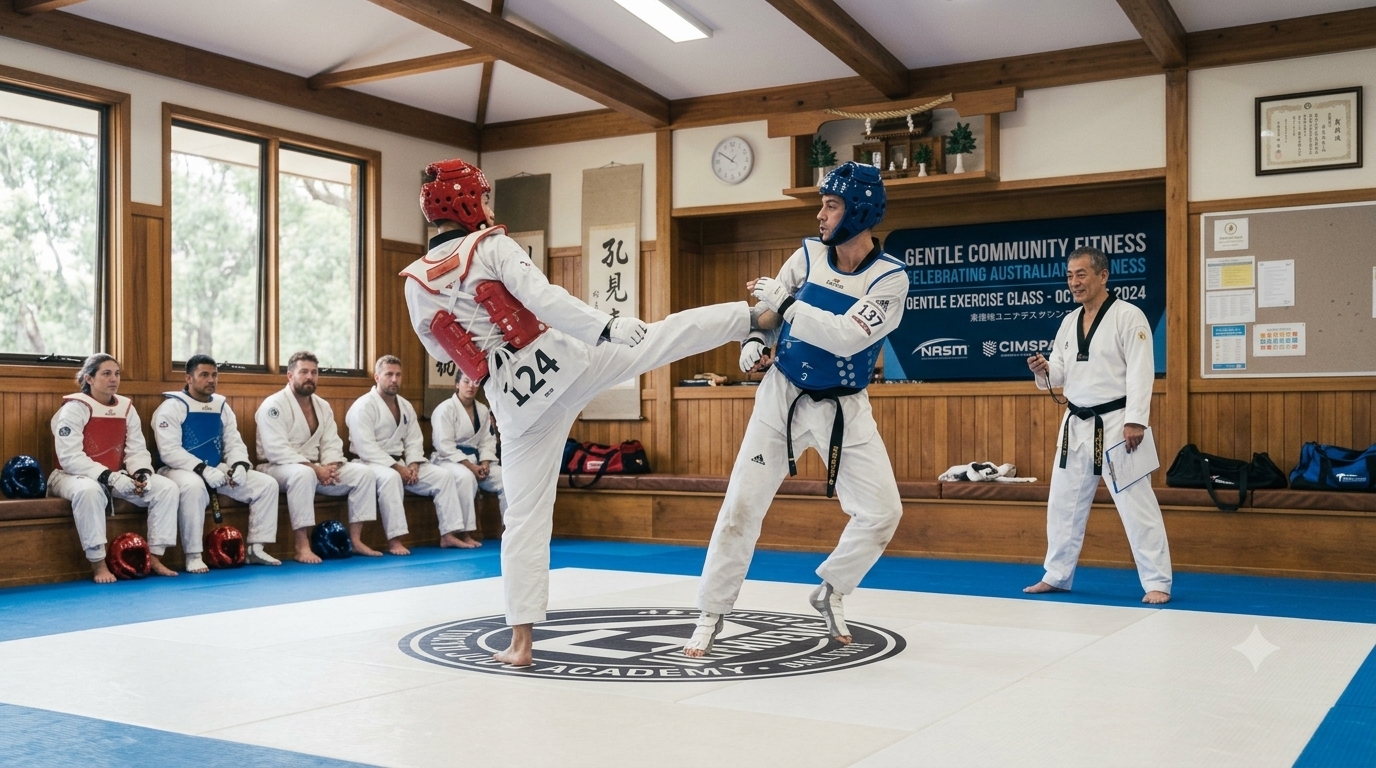
A properly executed roundhouse kick travels nearly two metres and generates forces three to four times greater than a comparable punch. In purely mechanical terms, the kick is one of the most powerful natural weapons the human body produces. Three traditions — Taekwondo from Korea, Capoeira from Brazil, and Savate from France elevated the leg into an art form of extraordinary sophistication. Each carries specific insurance implications that school operators should understand.
Taekwondo: Olympic Pathways and Head Contact
Modern Taekwondo has a well-established competition infrastructure through Taekwondo Australia, and its inclusion in the Olympic Games since 2000 has created a generation of practitioners pursuing structured competitive pathways. For school owners operating within this system, the insurance considerations centre on two specific areas: head contact in sparring, and competition event coverage.
The Olympic-format competition system rewards head kicks and spinning techniques — which means that serious Taekwondo schools are training students to deliver and receive high-impact strikes to the head. This is a different risk profile to non-contact or light-contact formats, and it needs to be specifically declared in your school's policy. A policy declared around 'Taekwondo instruction' that does not specify the contact level of sparring may not respond clearly to a head-contact sparring injury.
Competition events — local tournaments, state championships, and national events — require separate consideration from your school's ongoing policy. If you send students to external competitions, confirm what your policy covers during the supervised training leading to those events. The competition day itself is typically the organising association's insurance responsibility, but confirming this in writing before the season begins is sound practice.
Capoeira: The Moving Art and Its Unique Training Environment
Capoeira's unique structure — techniques embedded within rhythmic, flowing movement performed to live music — creates a training environment unlike any other martial art. The jogo (the game) between two capoeiristas involves continuous exchanges of kicks, sweeps, and evasions that to the uninitiated can appear almost indistinguishable from dance.
From an insurance perspective, the key questions for a Capoeira group are about contact level and supervision structure. Is your jogo light and controlled, or does it involve genuine full-speed exchanges? Are beginners paired with experienced practitioners in ways that account for the significant skill gap? The acrobatic elements — cartwheels, handstands, backflips — carry their own injury risk that needs to be within your declared scope.
Capoeira groups in Australia often operate in community halls, parks, or casual spaces rather than dedicated dojos. If your group trains in venues other than a fixed address, confirm that your policy covers activities at all the locations you use, not just a primary declared venue.
Savate: The Shod Foot and Product Liability
French Savate's defining characteristic — kicking with a shod foot — creates a specific consideration that is genuinely unusual in martial arts insurance. Practitioners wear purpose-built leather footwear as a standard training element. If a technique delivered with a shod foot injures a training partner, the question of whether the footwear itself contributed to the injury introduces a product liability dimension alongside standard Public Liability.
Savate's combination of boxing and kicking also means that students are regularly receiving full-power punches as well as kicks — a dual striking context that needs to be declared clearly rather than described as either 'kickboxing' or 'boxing' in isolation.