Weapons Martial Arts Insurance Australia | Kali Ninjutsu Iaido
Why Kali, Ninjutsu and Iaido Practitioners Need Specific Not General Martial Arts Insurance
There is a counterintuitive truth that most experienced martial artists eventually discover: training seriously with a weapon makes you dramatically better without one. The weapons arts — Kali from the Philippines, Ninjutsu from Japan, and Iaido, the Japanese art of the sword draw — each represent complete martial philosophies expressed through a weapons-centred lens. They also represent a specific insurance category that requires deliberate attention.
The presence of weapons in training — whether rattan sticks, wooden swords, traditional blades, or improvised tools — changes the risk profile of a session in ways that a standard martial arts school policy may not automatically address. Getting the declaration right is not bureaucratic detail. It is what produces a policy that responds clearly when an incident involves a training weapon.
Kali: Rattan Sticks, Live Blades and the Training Progression
Filipino Martial Arts — Kali, Eskrima, or Arnis — are among the most practically effective weapon systems ever developed. The foundation of training is typically the rattan stick, which can simulate a blade, a club, or an improvised weapon with minimal modification. For most of the training cycle, rattan sticks are the training tool. In more advanced practice, live blades may be introduced for certain drills.
The distinction between rattan stick training and live blade work is significant from an insurance perspective. Most martial arts policies can accommodate stick-based impact training with appropriate supervision declarations. Live blade training introduces a qualitatively different risk category — one that your insurer needs to specifically know about and specifically assess.
If your Kali program includes any live blade elements, declare this specifically. The answer from your insurer may be that the policy accommodates this with specific supervision conditions, or it may require a specific endorsement. Either outcome is better than an undeclared live blade incident creating coverage uncertainty at the worst possible moment.
Ninjutsu: A Broad Weapons Curriculum and Diverse Venues
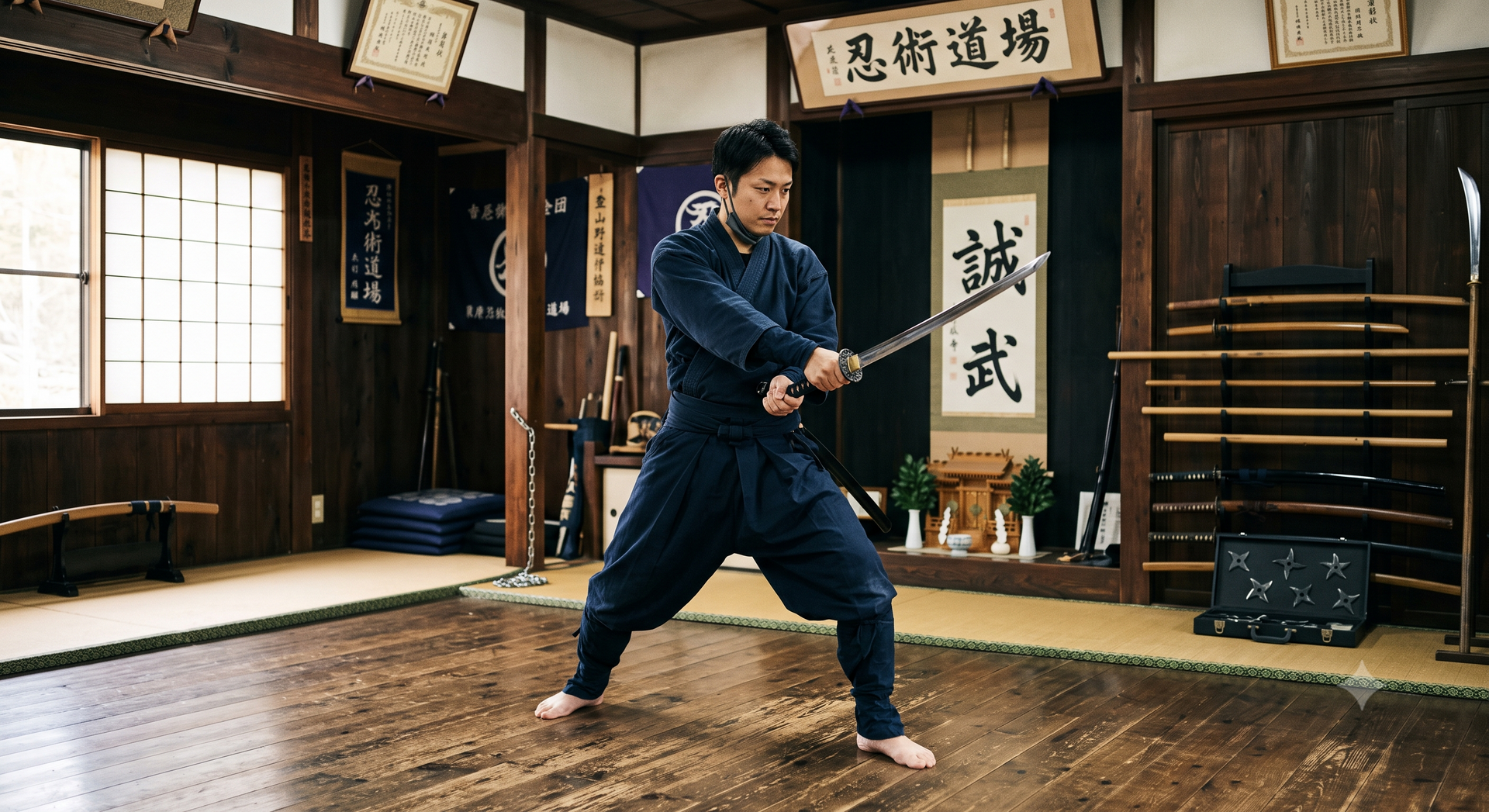
Traditional Ninjutsu maintains an extraordinarily broad weapons curriculum — katana, shuriken, bo, naginata, and numerous improvised tools — within a comprehensive survival and martial system. Bujinkan dojos operating in Australia train with a range of weapon types that require specific mention in policy declarations.
Ninjutsu dojos also frequently train outdoors or in varied environments as part of the art's emphasis on adaptability. If your training includes sessions outside your primary venue — in parks, at camps, or in other outdoor settings — confirm that your policy covers activities at these locations. A policy tied to a single dojo address does not automatically follow you to a woodland training session.
Iaido: Live Blades, Solo Practice and the Precision Imperative
Iaido is, at its technical core, the Japanese art of drawing the sword — and serious practice involves the use of a live-bladed katana or its training equivalent, the iaito. The absence of partner practice in traditional Iaido might suggest lower injury risk than partner-based arts. The presence of a live blade means the consequence of any error — in the draw, the cut, the resheathing — is potentially severe.
Insurance for an Iaido school requires specific mention of both the live blade element and the iaito training. The supervision structure during live blade practice — who can train with what weapon, under what conditions, at what experience level — is a specific underwriting consideration. Iaido often shares dojo space with Kendo; if your school operates both, both need to be accurately declared and the combined risk profile assessed.
The Empty-Hand Benefit and Its Insurance Implication
Experienced practitioners across all three arts report that weapons training dramatically improves their empty-hand ability. This cross-training reality also has an insurance implication: if your program blends weapons training with empty-hand martial arts, the combined risk profile of the school needs to be accurately declared as a whole rather than each element described in isolation.
A Kali school that also runs BJJ classes is not simply a Kali school — it is a blended operation with distinct risk elements that together constitute the real picture of what happens in your training space.